
I was at a party recently. There were many women there around my age. This is the time when the middle-age spread sets in, and for many at the party, it had begun. There were also complaints of sore knees and hips, as well as not having enough energy and other maladies. Some of the party goers were taking part in a packaged food dietary supplement plan, which, from where I stood, was not working too well.
Many people believe if they lose weight then they will be healthy. But this is not necessarily true. A lack of calories will automatically take the weight away, but once you return to your old ways, the weight will return. It’s logical.
Diet Powders and Potions
There are many diet powders on the market. Some are sold through multilevel marketing pitches, health food stores or pharmacies while others are medically endorsed. No matter what or where you get them, these powders are usually made up of fillers, colours, flavours, artificial sweeteners, thickeners and a slurry of fake vitamins and mined minerals. They are not necessarily food, but food-like substances.
There are two problems with these low calorie powders; firstly they do not teach you a new lifestyle and way of eating – once you finish and go back to your old way of eating, the weight comes back, and, secondly, they are not necessarily good for your physical and mental health. While they may seem good in the short term (as you lose the weight), in the long term they are not a sustainable method for achieving health and managing your weight.
Many of the powders are based on genetically modified (GMO) compounds and foods and this poses a problem. GMO foods have been on the market since 1996. Since that time, more research is discovering that these foods are not what the creators have made them out to be. To understand more, read the chapter in my book Changing Habits Changing Lives on GMO foods and the chemicals used in association with them.
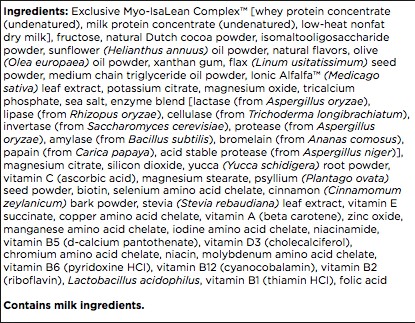
Below are the ingredient lists of two samples of these low calorie powders. I’m not sure about you, but this is not what I call real food – it’s just someone’s idea of what they think should go into a dietary supplement powder and there is no science to testify what these food-like substances taken in combination are doing to the total health of humans. If anyone has seen the research, please send it my way.

What does the Dietitians Association of Australia (DAA) Endorse?
The DAA recommends the following for weight management (it’s currently listed on their website):
“The best way to get in all the nutrients you need is to eat a variety of foods from these five groups every day:
- Plenty of vegetables, including different types and colours, and legumes/beans
- Fruit
- Whole grains such as breads, cereals, rice, pasta, noodles, polenta, couscous, oats, quinoa and barley
- Lean meats and poultry, fish, eggs, tofu, nuts and seeds, and legumes/beans
- Milk, yoghurt, cheese and/or their alternatives, mostly reduced fat
- And drink plenty of water.
And limit foods containing saturated fat, added sugars, added salt and alcohol.”
While it is better than powders, it’s a one-size fits all prescription and if for some reason you have sensitivities to some of these foods, it may present health and weight problems. Having said that, as dietitians they do individually consult with patients. There are many foods on this list that are posing real issues to people these days due to agricultural practices (I discuss this in my documentary What’s With Wheat?). These foods include conventional noodles, pasta, couscous, oats, barley, breads, cereals, tofu, legumes, beans and dairy (reduced fat).
If we take an historical perspective of these dietary guidelines, we find that since they started in 1982, they haven’t necessarily been a positive influence on the waist lines and health of the nation. And I notice they still have a hang up about saturated fat and salt (that’s for another blog).
The Commonwealth Scientific and Industrial Research Organisation (CSIRO) believes that restrictive diets and unscientific diets are detrimental to health and wellbeing. I am of the opposite opinion.
Why Restrictive Diets Work
A restrictive food group diet, if done right, will flush out any hidden food sensitives. Plus, if you do take grains, legumes, and dairy out of the diet, it might be hard but it definitely won’t kill you; in fact you might feel better. Humans have lived without these foods for thousands of generations without causing any peril to health.
A restrictive calorie diet, or even fasting, using real foods both have roots in evolutionary and historical survival since the beginning of time. I wrote an article on how this works, which you can read here.
Can we Really Rely on Scientific Proof When it Comes to Diet?
As for scientific proof, I’m not really sure that science can be completely accurate when it comes to diet and humans as every human is different. Every human may have a different health issue, the food may not be digested, absorbed and/or assimilated in the same way, the microbiome will always be different, they will have varying exposure to chemicals, different genetic alleles that change metabolic paramaters, and so on. These may all make it hard to ensure rigorous scientific accuracy.
This even applies to epidemiological studies, where food waste may not be taken into account and may not be accurate and you are relying on what subjects in a dietary experiment recall of what they ate. Notoriously we lie as humans about our food consumption and what and how much we eat. I see this so often as a nutritionist.
History lessons and a glimpse into cultures that still live traditionally may be able to assist us when seeking to understand what our body needs and how we adapt to what is available to us. Humans are incredibly adaptive to their surroundings and the food that is available to them; you just have to look at the diversity of foods and cultures around the world.
History can teach us so much. After all, it was a mother’s role to teach her young what to eat, how to prepare it and what would make them sick. At this point in history we have lost the art of traditional cooking, eating, fermenting, baking and sharing.
My thoughts on weight loss diets are that they need to be based on real foods for positive outcomes for health and weight loss, whether they involve fasting, or restricting calories or food groups.