

Last week with the introduction of the new dietary guidelines in the US, if you were in my home when I saw the news you would have seen me jump for joy.
The History of Dietary Guidelines
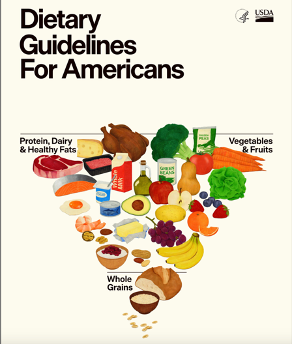
The new USA dietary guidelines are based on real food. There is not a breakfast cereal, modified milk, ultra-processed food, margarine, vegetable oil, soft drink within cooeee of the guidelines.
Instead meat, fish, chicken, eggs, whole milk, dairy, fruits, vegetables play a prominent role in the new upside down pyramid. Gone are the plate and the old pyramid and in its place is the new real food guidelines.
It was 1982 when the original guidelines entered Australia, based on the 1970’s USA dietary guidelines. The pyramid was weighted for grains, legumes, fruits and vegetables with breakfast cereals getting a mention in the eat mostly section. Then dairy, lean meats, fish, eggs and chicken are to be eaten moderately, with reduced fat spreads, polyunsaturated fats, canola, olive, margarine and butter and lastly sugar was on the small eating portion.
The 1999 version saw butter and salt removed completely. There has been plates and different versions of a similar theme of a high carbohydrate, low fat, low salt diet throughout the last 4 decades.
I started my studies in 1980 and finished my nutrition degree in 1984. I was taught the dietary guidelines, for a brief time I thought low fat was good but soon learnt that it was not part of our history of eating and changed back to full fat for my clients with real foods. I was a vegetarian at the time but did not push that as my agenda but rather taught a changing habits approach to going away from margarine, white bread, table salt, breakfast cereal, plastic cheese, and processed food to a better-quality real food diet. The new US dietary guidelines almost show a complete reversal of the 1982 Australian dietary guidelines, and it’s about time.
Since 1982 health has plummeted in Australia with chronic disease being the leading cause of death. The WHO has predicted by 2045 that 88% of the world’s population will die from a chronic disease. A chronic disease, or a lifestyle disease or a non-communicable disease, usually includes preventable maladies like, diabetes, heart disease, cancer, metabolic disease, fatty liver disease, and autoimmunity. In 1964 in Australia, chronic disease was at 4% across the board, now our children have a chronic disease rate of 36% and after the age of 60, 80% of the population has a chronic disease.
Reactions to the New Dietary Guidelines
Social media has gone ballistic. Everyone interested in the health of their nation is posting about the new guidelines and for those people I follow, they are like me, ecstatic that the status quo of low-fat high carbohydrate ultra processed foods has been toppled.
It’s interesting to note as I read through the comments that the negative nancys are dietitians and those who have been captured by a narrative like personal trainers, nutritionists, and of course some of the loudest are the least qualified of all: doctors and their associations. While some medical associations applaud the new guidelines, in the US, the Physicians Committee for Responsible Medicine have said it is industry funded. This is the pot calling the kettle black.
I’ve never followed the dietary guidelines; I walk to the beat of my own drum. I teach a real food mantra based on anthropological principles and the history of eating with the philosophy of vitalism as opposed to nutritionism as guiding principles. I’ve been guided by this my whole nutrition teaching career. You could call me a seasonal locavore for the most part using foods grown in my local area without chemicals by farmers who do not use chemicals but rather regenerative farming practices including my farm The Changing Habits Farm.
There will be other people who do not follow these guidelines and others may follow bits and pieces of it. But where it is most important is institutions, such as hospitals, school food programs, aged care, military. These institutions all rely on the dietary guidelines for dictating their food choices.
Hospital breakfasts include breakfast cereal, modified milk, white sugar, white bread, margarine and jam. This depicts the current dietary guidelines. I was given a military ration from a friend, and every food was packaged and ultra-processed, there was no good quality fats, rather a lot of sugar, sugar-like substances and additives to a mainly high carbohydrate ration. My father was in an aged care facility toward the end of his life, the food they served him was ultra-processed and high in carbohydrates, vegetable oils and margarine, there was very little fresh food and quality proteins. He had the ability to cook for himself but going to the cafeteria was an easier option and soon he was eating only from the cafeteria. When my children were in school, I tried repeatedly to change the tuckshop but because real food did not follow the dietary guidelines, I could not make a difference. I am sure you all know these scenarios. So when someone says ‘no one follows the dietary guidelines’ it’s very inaccurate. institutions with large numbers of people who need good nutrition must follow these guidelines. I see the USA dietary guidelines as a positive effect that will ripple through these institutions and if Australia follows suit, we may see the same.
The Future of Australian Dietary Guidelines
The Australian Dietary Guidelines have been under review since 2024, the new ones are expected sometime in 2026. What is expected at this point is a balanced, varied and moderate diet, with more accessible information on sustainable eating, including low environmental impact diet, prioritising plant-based protein and nuts. And finally in alignment with international trends to consider planetary health alongside human nutrition. It’s going to be an interesting contrast to the US guidelines but if they are talking about international trends we may be in for a surprise. I’m not holding my breath but keen to have a peek and would love to be a fly on the wall in the committee room after the release of the US dietary guidelines.
The question to ask is: What is the difference in the human body between people who live in the US and those that live in Australia and if there is no difference then why would we have different dietary guidelines?
In the US the USDA (department of agriculture) is the constructor of the guidelines while in Australia it is the NHMRC (health and medical research). I also noticed that the Dietitians Australia who declare that they are the leading voice in nutrition and dietetics have not made comment on this historic event in food and nutrition. I keep going to their socials but so far ‘crickets’.
The Truth about The Nutrition Academy
The Nutrition Academy, my education facility has been at the forefront of real food education, defying the dietary guidelines and nutritionism, to teach history of eating, cultural anthropology and vitalistic philosophy. These incredible guidelines that I’ve used for 45 years and are the foundations of my Functional Nutrition Essentials Course have been an incredible guide that has not been wrong. While the official dietary guidelines are changed every 5 years or so because of recent research or industry funding or agendas, The Nutrition Academy has had no need to change the food and nutrition education but rather we just keep updating our references as nutrition science catches up to what we know has been true all along.
We have survived on the same foods for thousands of generations, adapting to different terrains and eco systems to survive in sometimes hostile environments. Someone at the bottom of South America will exist on mainly animal, fish and birds with berries in the summer, compared to someone living in the highlands of Papua New Guinea where plants are abundant and animals such as small rodents, or to the deserts of Africa where herding is their way of survival and meat and milk play a huge part in the diet. We can adapt to different environments where different foods are found, real food from the land, not ultra-processed fake foods from a laboratory.
We have never adapted to the modern grocery store that offers thousands of packaged products all synthesised in a lab, flown in from the other side of the world that blocks our innate intelligence of where we are in longtitude, latitude and altitude. You are an innate intelligence, given the right ingredients, seasonal local foods, sunshine, sleep, movement, grounding, connection all play a part in the health of an individual.
Doctors diagnose and treat with medications. Alternative doctors diagnose and treat with supplements the doctor of the future will ask you about your diet and lifestyle, get the fundamentals working and then see if there is need for drugs or supplements.
It’s not hard, it’s common sense but common isn’t common anymore.
The Functional Nutrition Essentials Course is about finding your common sense, the first two modules teach the philosophy of vitalism (holism) and cultural anthropology, then from there looking through these lenses we look at the digestive system, immunity, salt, sugar, cholesterol, fats, diet-based solutions and so much more.
This is an education to help you firstly and then if you wish to take it further you can help your family and even community. We need more real food advocates that understand the why out in the community, teaching people a better way to health. Insanity is doing the same thing and expecting a different result.
It’s time the dietary guidelines changed so a new outcome will be health and not chronic disease.
Cyndi O’Meara
Nutritionist.