
Health Star Rating is now Mandatory in Australia.
The Dietitians of Australia are beyond pleased that the Food Ministers have greenlighted the mandate for the Health Star Rating (HSR).
The Dietitians of Australia call themselves the leading voice in nutrition and dietetics.
If this is leading the way by giving 5 HSR to ultra-processed foods and less than one star to real food, the Australian public who blindly believe in the star rating will get sicker, more obese and our sickness care dollar will rise.
Time to educate about what the health star rating (HSR) is.
What actually is the Health Star Rating in Australia?
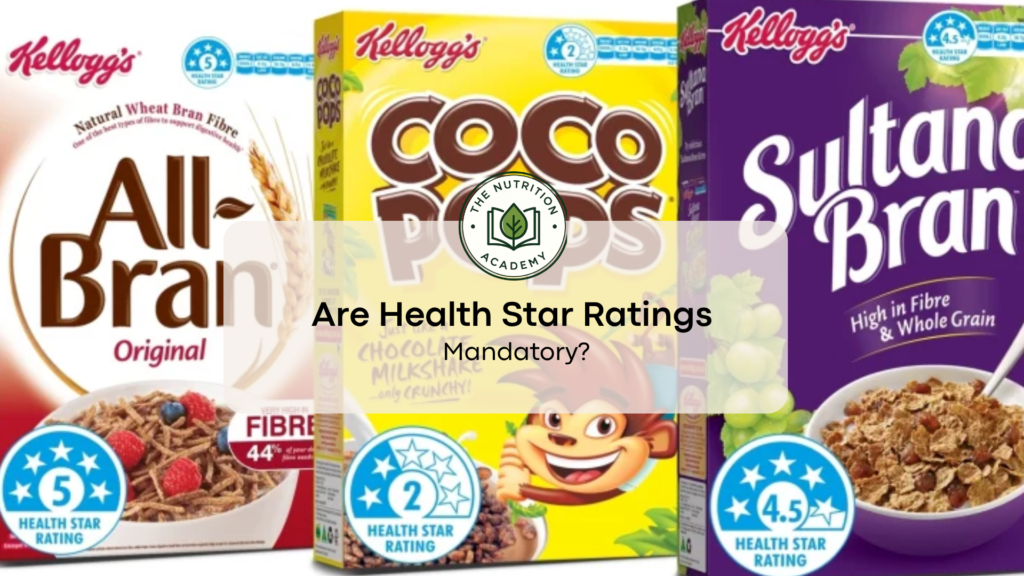
The Star Rating at present is voluntary. It is based on calories, saturated fat, sugar and salt and looking at protein and fibre. In the star rating you can only compare apples with apples. What that means you cannot compare a 4.5 star on a breakfast cereal with a 4.5 star on a yogurt. I would have thought that 5 star was healthy and .5 star was unhealthy no matter what the food was, but this is not the case in the HSR. It’s based on category.
We have been duped into the HSR algorithm that looks at the mechanics of the food rather than looking at the whole food. At The Nutrition Academy our very first module in the Functional Nutritional Essentials Course is to teach the difference between the philosophies of mechanism and vitalism. They are opposing philosophies. Both have their part to play in healthcare and food.
Mechanism is where we look at the nutritional label of a packaged food, where we view calories, carbohydrates, protein and fats with vitamins and minerals and if we believe that it is perfect as in the Health Star Rating, based on flawed science and beliefs about these components of food, we then miss the whole picture of what the food really is. For instance a perfect food 5 star may have what is deemed to be the perfect balance of minimal saturated fat, salt, sugar and calories but when we look at the vitalistic part of the label, the ingredients, we see the food is based on flavours, acidity regulators, preservatives, gums, thickeners, colours, vegetable oils, emulsifiers, artificial sweeteners and refined grains.
This is an ultra-processed food and no matter how good the lack of saturated fat, sugar, salt and calories is, it is a food that causes, metabolic disease, diabetes, fatty liver, and gut issues.
Thank goodness there are public health figures calling for the algorithm underpinning the rating to be overhauled. Dr Phillip Baker from the University of Sydney says that the HSR should reflect if the product is ultra-processed containing high levels of industrially formulated chemicals as described above.
42% of the Australian diet is ultra-processed, one of the highest percentages in the world. Only the USA, Canada and the United Kingdom consume more of these foods. Research led by Dr Baker and published in the Lancet Medical Journal described the rise of ultra-processed foods in the diet as an ‘urgent public health threat’.
The research analysed 100 studies and found an association between high levels of ultra-processed products and an increased risk of obesity, type 2 diabetes, hypertension, cardiovascular disease and other chronic diseases.
I don’t think that this study has come as a surprise to the students and graduates of The Nutrition Academy and critically thinking humans. The second module of The Functional Nutrition Essentials Course dives into an historical aspect of diet in our ancestors. All food anthropologically speaking was real food, food in season and food in the local area. Latitude, longitude and altitude dictated sunshine, plant growth, animal habitations which all dictated an incredible variable human diet depending on where you lived on the planet. There was no one diet. But I can guarantee never in the history of human eating have we eaten foods made from industrial chemicals which are loosely called ingredients. And never in the history of human health have we seen so much chronic disease.
Many ultra-processed foods are sneaking into the diet in the pretence of being healthy, examples are breakfast cereals, vegetable spreads (margarine), protein powders, muesli bars, keto bars, modified milks, baking goods….
Why Are Some Ultra-Processed Foods Considered ‘Healthy?”
But of course The Australian Food and Grocery Council representative said that food processing made food safe, affordable and accessible for consumers. I beg to differ with this statement, it may be free of bacteria and microbes (safe), but is it really safe to eat for health outcomes? It may be affordable but at what cost to the health of individuals and a nation and the cost of health care in this country? We already spend $270.5 billion on health care increasing each passing year, that’s 10.1% of GDP, as opposed to the armed forces which is 2% of GDP at $59 billion.
With the World Health Organisation predicting that by 2045 chronic disease will contribute to 88% of deaths in the world, it would make sense to figure out what was causing chronic disease and it seems that ultra-processed foods may be a leading role in this decimation of human health.
To give a 5-star rating based on saturated fat, salt, sugar and calories and having no consideration to ultra-processed foods seems a recipe for health disaster.
Ultra-processed Foods vs Natural Foods
Let’s look at some examples:
Butter has a health star rating of .5 to 1.5 depending on salt content. It is made from cream and salt – 2 ingredients. The reason for butter to have such a low rating is saturated fat, salt content and cholesterol. 15gms of butter (1TBS) will contain 31mg cholesterol and 7.2 grams of saturated fat. My question when I look at this food vitalistically is what is the rest of the fat and why are we worried about 31mg of cholesterol when the body makes 2000mg approximately of cholesterol every day.
Butter contains approximately 50% saturated fat including stearic acid and butyric acid a very important fat for the gut lining health. Around 29% of fat is monounsaturated with oleic acid being the dominant one. 3-5% is polyunsaturated linoleic acid (an essential fatty acid) and other lipids being cholesterol and fat soluble vitamins including A, D, K and E. This is a vitalistic food made by nature, processed slightly by man by churning, and salt is added. It has been consumed by our ancestors for 1000’s of generations.
On the other hand Nuttelex an example of a vegetable spread has a 4 star rating due to being low in saturated fat, salt and sugar. It’s ingredients are all industrialised including: interesterified refined vegetable oil (this makes a liquid solid at room temperature and creates an interesterified fat (not found in nature)), water, salt, emulsifiers (471), natural flavours, Vitamin A D E (all synthetic) natural colour. There is nothing natural about the word natural in these ingredients. I explain this in my book Lab to Table…
What’s not on the label of Nuttelex are the chemicals used in farming the soy, canola, sunflower, cotton seed for the vegetable oil and the chemicals behind the word flavour. This is the disparity of the HSR.
We also have to consider why have we targeted calories, saturated fat, salt and sugar as the key drivers of the HSR. A calorie is not necessarily a calorie. A diet of fruits, vegetables, meat and dairy in calorie terms is far different to a diet of ultra-processed foods of the same amount of calories.
Healthy Salt Quality and Quantity
Salt has been part of the diet of 1000’s of years. The word salary comes from salt as many people were paid in salt. Salt roads are 3000 plus years old. Refined salt is different to land and sea based unrefined salt, one has 2 minerals with some anticaking agents and free flowing agents and the others have up to 86 minerals. Salt and hypertension has a bell shaped curve meaning too much is not good but too little is just as bad. Salting your food to your taste should be the right amount of salt.
Refined, substituted and artificial.
Sugar and carbohydrates have also been a part of the diet for 1000’s of generations, in fact since the beginning of time. It’s the refined sugars and sugar substitutes and sugar replacements that we should be more worried about than the natural sugars in our food.
Is Saturated Fat bad?
Saturated fat has always been in the diet. The vilification of this fat and the need for less and less has become a religious verve not necessarily based on good science. Saturated fat provides essential energy, supports cell membrane structure and aids in the absorption of Vitamins A,D,E and K. It increases HDL cholesterol the carrier deemed to be healthy by humans that carries cholesterol from the tissues to the liver for storage ready to be used to make hormones and Vitamin D to name a few. It promotes hormone production and aids in brain health. It is a fat that is found in plants and animals and throughout nature and the human body. The brain is 60% fat, with a significant proportion being saturated fat. I am dumbfounded that saturated fat is still being seen as a dangerous fat. We should be more worried about man made trans fats as a result of hydrogenation of a vegetable oil (margarine) and man made interesterified fat (vegetable spread) which have been shown to cause prediabetes in 6 weeks of consumption.
It’s also important to realise that saturated fat does not exist in a vacuum when entering the body. If we look at the fat vitalistically how it affects the body is influenced by the amounts of cholesterol, polyunsaturated fat, whole vs ultra processed diet, exercise, genetics, carbohydrates in the diet to name a few. When we pin point macro nutrients and isolate them and say they are bad we are not looking at the big picture of how they synchronically work together.
By using vitalism and historical perspective when it comes to what we should be eating for our health and wellbeing and longevity we don’t get hoodwinked into believing the industry lies.
If you want to keep your family safe learn with me through The Nutrition Academy and never doubt your food choices again.
Cyndi O’Meara
BSc. Nutritionist 45 years
Founder The Nutrition Academy
Producer of the Documentary What’s With Wheat.
Author of Lab to Table – How to stop being a lab rat and make better choices for your table.