
The USDA has just allowed for lab grown meats otherwise known as cultured meats (not to be confused with plant-based meats) to be available in the US human food supply. FSANZ, the Australian food regulatory body has received an application from an Australian company – Vow, to have cultured meats allowed in our food supply.
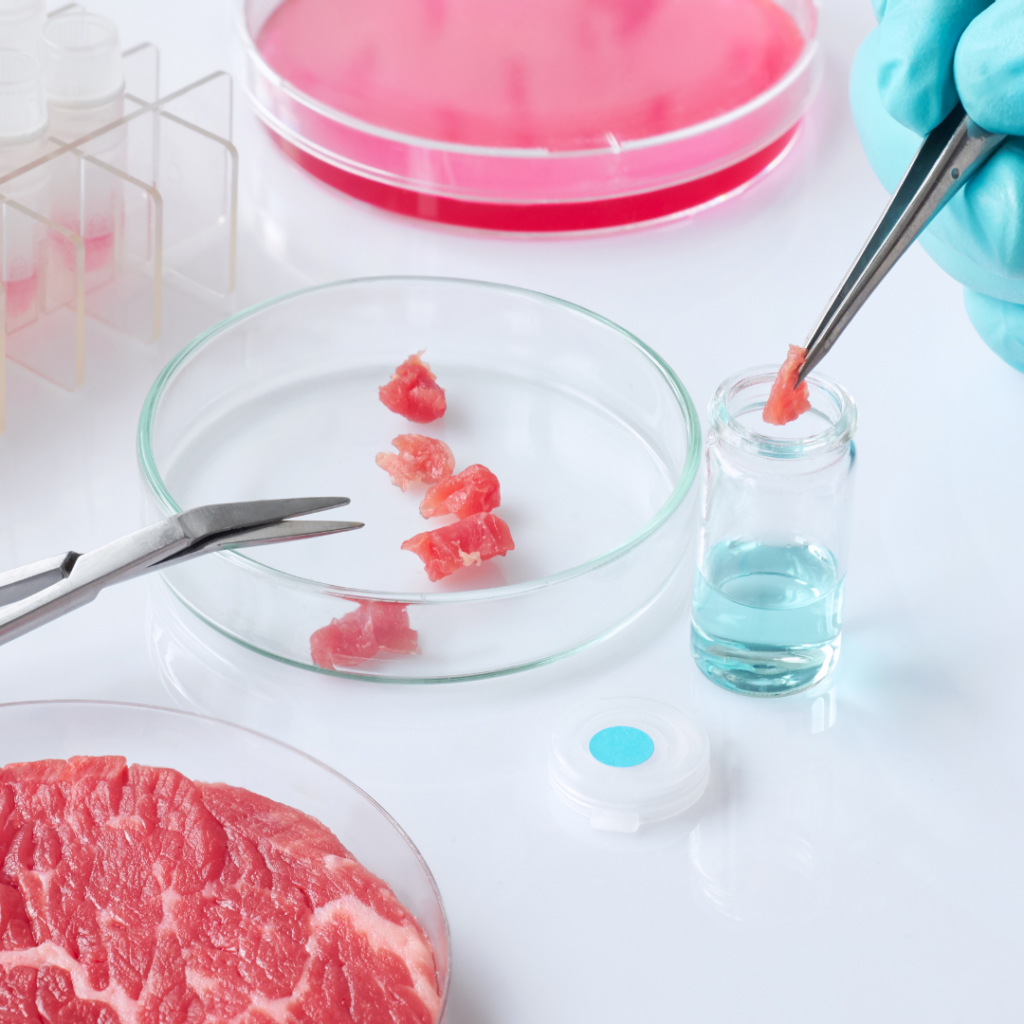
I thought it was time for me to find out something about how this cultured meat is created. Before I start, I must say that I did not expect to see so much complexity in the manufacturing process, beginning with the animal cells, how they are collected, to what they are fed, to the scaffolding required for 3D meat, the equipment needed, the monitoring, the bioengineering, the animal bioproducts (from dead animals) required, the electricity to fuel these massive bioreactors and factories and more.
It is so complicated, using vast amounts of resources from multiple companies from around the world to produce cultured meat. In fact, it makes no sense to me why this is even factored into something that is viable and is going to feed the world and save us from the climate dilemma.
Farmed vs Cultivated Meat
I have 60 acres, I breed cattle and I have chickens for eggs, it takes one farmer a small amount of time each day to check on the animals and every couple of days move them and make sure they have water. My cows eat the grass that’s created by sunshine, soil, its ecology, and water. Magically, my bull can mate with my cows so that they grow a complete calf, which then drinks milk and eats grass and gets big to breed more cows.
I do not have people on my team who are bioengineers, software, IT, mechatronic, process and/or R & D engineers as well as food inventors and other scientists and computer nerds. I have a farmer whose partner is mother nature and who works to create harmony within a system of plants and animals. As a result we have more organic matter, more water holding capacity, more ecology, and more carbon capturing ability then a bioreactor in a factory with stainless steel vats requiring vast amounts of electricity to keep the cultured lab meat growing.
While the USDA has allowed for these cultured meats in the food supply, the problem now is the time to upscale the cultured meat manufacturing. A single plant with bioreactors and equipment costs around US$650 million dollars to produce 15 million kilograms of meat. The price per kg of cultured meat is exorbitant. Already billions of dollars in start-ups have been used and billions of dollars will be needed to upscale the operation. Some of these start-ups have patents on cultured meats, while others have trade secrets.
Most manufacturers know that they will probably not make a profit for a decade due to the cost of production. They will sell the expensive cultured meat cheap so that people will get a taste of something that they may believe to be the cheaper, better alternative. I do not believe health has anything to do with cultured meats.
There are no long-term studies that this meat is healthy for human consumption, some see it as another ultra-processed food. And after reading the patents, seeing the food fed to the cells, the materials in the scaffolding, I too would believe it to be an ultra-processed food and possibly with some contaminants (e.g. PEG’s) that the human body does not need for health.
How they get the cells for cultured meat
“The most common method to obtain starter cells is by taking a cell sample from a live animal, performed using minimally invasive methods. In some cases, these cells may also be acquired by taking the cells from a recently slaughtered animal where the tissue is still viable, which could be important for determining compliance to religious laws (e.g., halal, kosher). In all cases, the acquired cells originate from healthy animals alongside extensive documentation that ensure the quality and traceability of the cells”. (1)
One patent I read talked about the need for the following people to look after this animal including a biologist, a surgeon, a histologist, a veterinarian surgeon, a computer programmer, a chemist, a bacteriologist, a pharmacologist, a technical engineer and other scientific staff. The donor animals are kept under very strict environmental conditions, in quarantine, in clean rooms and with good feeding conditions (2). Cell banks are also being set up for every species of animal and fish around the world, alive or extinct.
These cells can also be genetically engineered to accelerate the development of cell lines suitable for cultivated meat. Engineering cell lines can improve the productivity of the process and influence the end products attributes, such as nutrition.
Genetic engineering creates permanent changes by either introducing, rearranging, or removing DNA. There are patents filed by companies producing cultured meat for the use of genetic engineering while others have said they will not be using GE. Time will tell as countries approve either GE or no GE on cultured meats and probably will depend on the sentiment of the country when it comes to synthetic biology and biotechnology and trusting food technology. (6)
The Food Fed to the Cells (otherwise known as media or medium)
The food or “medium” that the cells grow in is saline of the same consistency of what the cells would normally grow in under real life conditions. Added to the saline mixture are amino acids, each of these amino acids is either grown from synthetic biology or synthesized in a chemical laboratory. Certain vitamins are required, mainly the water-based vitamins, which will also be sourced from around the world from different chemical laboratories that are making these vitamins synthetically or using synthetic biology.
“Water-soluble vitamins including riboflavin (vitamin B2), nicotinamide (vitamin B3), pantothenic acid (vitamin B5), pyridoxine and pyridoxal (vitamin B6), biotin (vitamin B7), i-inositol (vitamin B8), folic acid (vitamin B9), cyanocobalamin (vitamin B12), and choline are typically added to and “essential” in cell culture media, sometimes in various modified forms to provide stability. Fat-soluble vitamins A, D, E, and K are excluded in basal medium formulations but can be added, if necessary, when dissolved in an organic solvent” (3)
The vitamins are added, taken away, and changed depending on the cell growth that is required. It is all monitored down to the single nutrient and amino acid.
A serum, taken from fetal bovine, chicken embryos and horses, is used to stimulate growth. This serum contains growth and attachment factors, hormones, antioxidants, vital nutrients, lipids and other components that mimic a proliferative fetal like state, but contains low levels of immunoglobulin. This (the natural mix of fetal … juices? In a lab context?) poses many problems from the contamination of virus, bacteria and other components in the fetal bovine serum. Whereas the synthetic creation of the serum allows for knowing exactly what is in the formulation. It’s interesting to note, new advances are reducing the need for this serum. Read this article to find out more.
Development of serum-free and grain-derived-nutrient-free medium using microalga-derived (small algae species) nutrients and mammalian cell-secreted growth factors as mentioned above for sustainable cultured meat production. (4)
Glucose is also required in the medium, possibly made from genetically modified corn or wheat with residues of glyphosate.
Hormones, growth factor, essential minerals, heparin, and cholesterol are all required in the medium for the cells to grow. If it is not coming from the serum it will need to be made synthetically and transported to the factories.
Buffers are needed to keep the pH at around 7.5. Buffer systems in cell culture typically consist of either CO2- bicarbonate systems or buffering agents such as HEPES (4-(2-hydroxyethyl)-1-piperazine ethanesulfonic acid.
I’ve seen in patents showing the need for a fungicide such as amphotericin B or for sterilization using irradiation and pulsed electric fields.
Usually, the medium is made off site as a dry ingredient mixture where clean water is added, but with the upscaling of bioreactors and plants there may be a need to make these mediums on site to avoid degradation of valuable nutrients.
I love that science has figured this out, but nature does this naturally without all this palaver.
Scaffolding to Make an Eye Filet.
Originally 2D cultured cells were for medical research and wound healing. Just like cultured oil began as biodiesel, now we have a 2D medical structure needing to change into a 3D food structure and this requires “scaffolding”.
There are different ways to make the scaffolding using synthetic polymers like PEGS and hydrogels, animal-based proteins like collagen and gelatin, plant or fungus-based proteins like algae and other microbes, self-assembling proteins and/or combinations of these scaffold ingredients, the list seems endless, it all depends on the characteristic of the ingredients as to how the scaffolds are assembled. (5)
Use Of These Cultured Meats
These cultured meats can be used for human and animal consumption and come in a form including sausage, spreads, cooked puree, pureed baby food, biscuit, dried granules, tablet, capsule, powder, pickled, meat product, smoked meat product, dried meat product and cooked meat product.
Economy of Scale
The idea is that this type of meat production will have less of a footprint on the planet, but it may be a decade or more away before this is possible. Firstly, if traditional energy is used and not renewable energy then a recent paper (2023) showed that the environmental impact would be between 4 and 25% worse off. (7) What is also in this paper is the environmental impact of the medium, the resources required to make each ingredient, the travelling, the mixing, the cleaning of the exotoxins and so much more make this far worse for the environment than grass and cow pads.
Propaganda Around This Cultured Meat
No matter whether I went to a company that was creating cultured meat or owned a patent, the selling point was that it would be better for Earth and climate issues, would feed billions and would solve the ethical dilemma behind the slaughter of animals. The videos on some of the websites were very dramatic and fear mongering. (8)
But what if the climate is cooling, after all they call it change now not warming, and what if animals help with the climate crisis and what if we stopped growing grain for animals and let the land that grows grain with chemicals be left as pastures for ruminants to graze on. There are so many questions to ask when we look at the planet, regenerative farming, cultured meats, and the dilemma we seem to face.
For me I will do what I can do by the food choices I make. I will nurture the land, grow food, choose ethical foods, buy local, buy seasonally, not buy ultra-processed packaged foods and I will not be buying into the cultured meat propaganda.
Cyndi
References.
(1) https://gfi.org/science/the-science-of-cultivated-meat/
(2) https://patents.google.com/patent/US7270829B2/en
(3) https://gfi.org/science/the-science-of-cultivated-meat/deep-dive-cultivated-meat-cell-culture-media/
(4) https://pubmed.ncbi.nlm.nih.gov/36627406/
(5) https://onlinelibrary.wiley.com/doi/full/10.1002/advs.202102908
(6) https://patents.google.com/patent/US6835390B1/en
(7) https://www.biorxiv.org/content/10.1101/2023.04.21.537778v1.full
(8) https://www.vowfood.com (watch the video)
Postscript.
An extract from The Science of Cultivated Meat.
How is cultivated meat made?
The manufacturing process begins with acquiring and banking stem cells from an animal. These cells are then grown in bioreactors (known colloquially as cultivators) at high densities and volumes. Similar to what happens inside an animal’s body, the cells are fed an oxygen-rich cell culture medium made up of basic nutrients such as amino acids, glucose, vitamins, and inorganic salts, and supplemented with growth factors and other proteins.
Changes in the medium composition, often in tandem with cues from a scaffolding structure, trigger immature cells to differentiate into the skeletal muscle, fat, and connective tissues that make up meat. The differentiated cells are then harvested, prepared, and packaged into final products. This process is expected to take between 2-8 weeks, depending on what kind of meat is being cultivated. Some companies are pursuing a similar strategy to create milk and other animal products.